Inevitable Rebirth
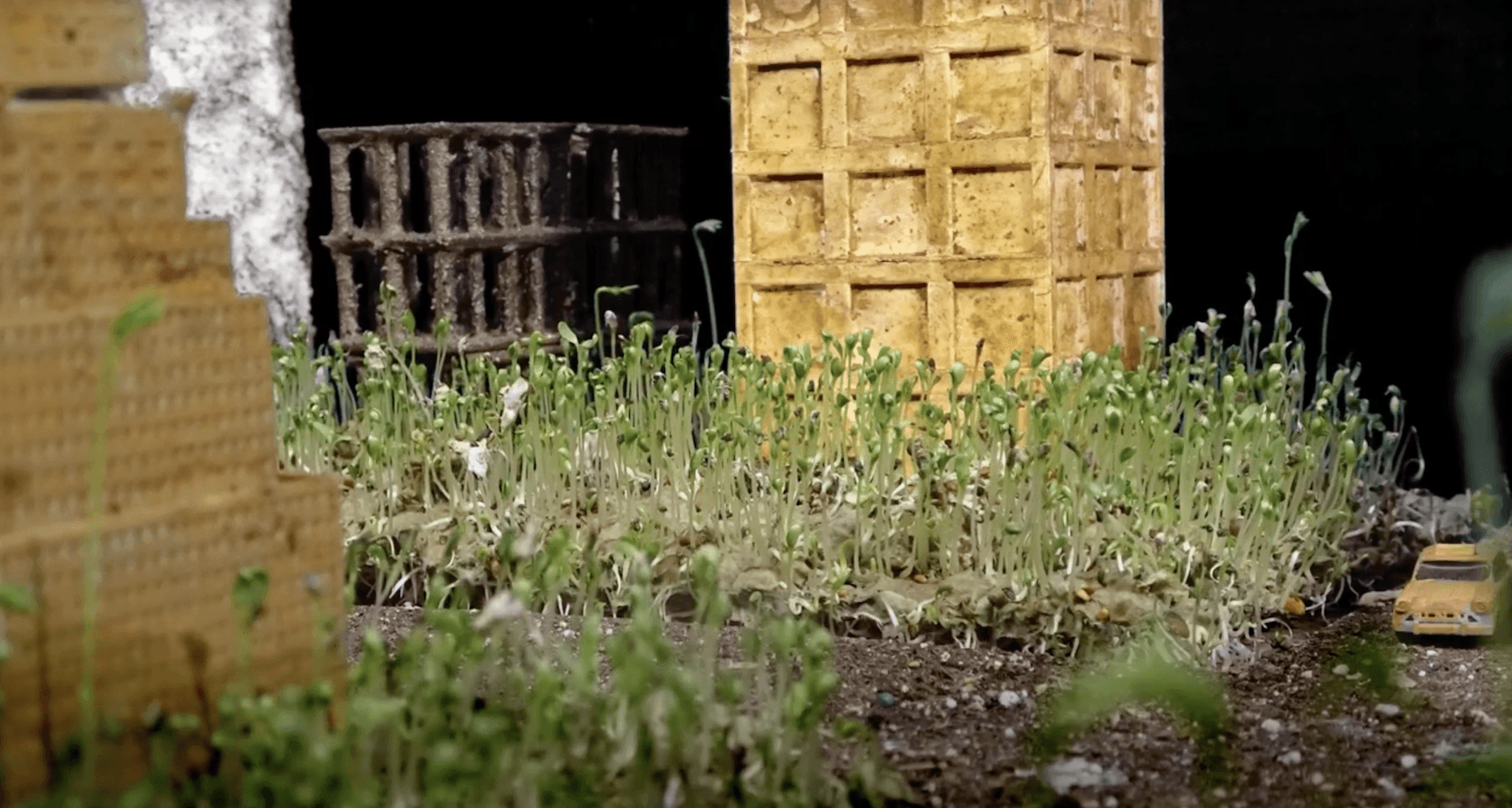
Context and Problem
This project was completed as a capstone for my B.A. in Emergent Digital Practices at the University of Denver. The class structure emphasized iterative ideation, feasibility experimentation, and multidisciplinary integration of physical computing, 3D design, and narrative media.
DESIGN QUESTION: If humans went extinct, what would the earth look like in the aftermath? What parts of the earth would regenerate and heal, and what evidence of human life would remain even years later?
DURATION: 20 weeks
Research
METHODS USED
This project relied on feasibility-driven experimentation rather than traditional user research, due to its speculative, physical-digital nature. I conducted a series of controlled material, scale, and hardware tests to evaluate what interactions and effects were realistically achievable within the project’s timeframe and technical constraints.
Feasibility Experiment 1: Biological Growth & Sprouting
Goal: Determine whether live plant growth could be reliably integrated into 3D-printed or wood-based architectural models to represent environmental overgrowth.
VARIABLES TESTED
Chia
Wheatgrass
Chia + wheatgrass combination
Sprout’s mixed sprouting seed blend
GROWING METHODS APPLIED ACROSS ALL SEED TYPES:
Seeds placed directly on scored plywood to increase surface porosity
Seeds grown on wet paper towels, then transferred to wooden building models once sprouted
Seeds grown in egg-carton cardboard pulp, then transferred to wooden building models
All methods received consistent watering and equal access to sunlight.
FINDINGS
Seeds grown in cardboard pulp produced the most consistent and dense growth.
Direct application to wood surfaces proved unreliable without a growth medium.
Feasibility Experiment 2: Large-Scale 3D Printing
Goal: Validate whether architectural models could be printed at a scale large enough to support embedded digital components.
CONSTRAINTS & METHODS
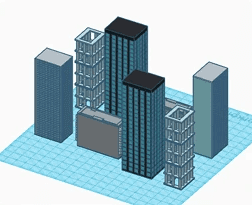
Used Tinkercad to test scale variations of building models.
Original design required:
Embedded Arduino-controlled LCD screens functioning as digital billboards
Buildings at least 1 ft tall
Minimum 5-inch width for at least two buildings
FINDINGS
Larger print scale significantly increased fabrication time and resource demands.
Printing in modular sections became necessary to maintain feasibility.
Feasibility Experiment 3: Simulating Time-Induced Corrosion
Goal: Explore whether gradual material degradation could visually represent environmental decay over time.
APPROACH
Programmed an Arduino-controlled water pump to produce a slow, continuous drip from within a building structure.
Tested whether building materials would visibly change through prolonged saturation.
ENCASING MATERIAL TESTS
Food-dyed coarse salt applied using a sugar-water binding mixture
Salt mixed with egg whites and applied as a paste
KEY QUESTIONS ADDRESSED
Which material best demonstrates visible change over time?
How thick should the encasing be to allow gradual erosion?
What application method maintains structural integrity while enabling decay?
FINDINGS
Salt-based encasings provided strong visual impact but introduced high unpredictability.
Liquid-based degradation added significant technical risk to system reliability.
KEY RESEARCH INSIGHTS
Early ideation emphasized technical novelty (3D printing, Arduino, animation) but lacked narrative cohesion until environmental storytelling anchored design decisions.
Cardboard pulp proved the most viable medium for representing biological overgrowth through live plant growth.
Hardware-driven effects (water pumps, salt corrosion, embedded LCDs) significantly increased system fragility, reinforcing the need for contingency planning and scope control.
Ideation
ARTIFACTS & TOOLS
Brainstorm Sessions: Collaborative breakout rooms helped identify compelling intersections between technology and environmental themes.
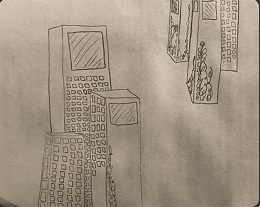
Journey Mapping: I sketched viewer journeys through narrative arcs — from capitalist ads to dystopian decay to planetary healing.
INSPIRATION
Climate Clock in New York City
Twenty one twelve exhibit by Jennifer and Kevin Mccoy
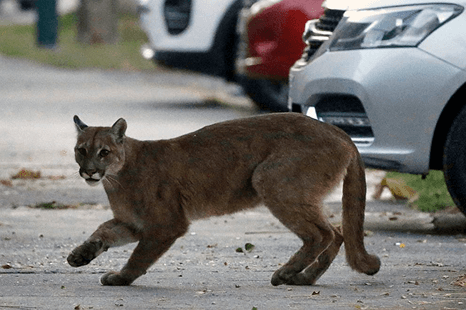
The return of wild animals to urban spaces during the absence of human activity during 2020 lockdown
CONCEPT
A post apocalyptic metropolitan city where nature has taken back the earth after the extinction of humans.
KEY FEATURES
Model building of various materials including 3D printed plastic and laser cut plywood.
Growing greenery throughout the city, including on the buildings.
Small LCD screens programmed with Arduino to display billboard advertisements for post-apocalyptic products: breathing masks, drinkable water as a luxury item, and doomsday shelters.
Screens as a commentary on humans valuing societal advancement over societal survival and thus our technology has outlived us
Active corrosion of a building to show time passing.
MEDIUM
Time lapse capturing the sprout growth, the building corrosion, and the flickering of the billboards advertisement.
AUDIENCE
This project targets both a general exhibition audience, and and audience of professionals in the creative technology field. The work invites viewers to question what society chooses to preserve, and the ethics of technological advancement at the detriment of human life.
Iteration
ITERATION 1: 10 WEEKS
What Worked
Successful sprouting growth
Successful camera angels and shot intervals
Improvements for the next iteration
The green screen was the same color as the sprouts which made post-production unsuccessful, next iteration to use a different color backdrop
Due to time and fabrication constraints, I scoped the project to remove the embedded LCD screens and water pump, prioritizing narrative clarity and physical completion over technical complexity.
Resin cars left unpainted (also due to constraints)
ITERATION 2: 10 WEEKS
What Worked
Successful sprouting growth
Successful camera angels and shot intervals
Successful blue screen
Painted resin cars
More time to work in post-production allowed me to edit in audio and a weather cycle to demonstrate the passing of time.
If I could do this project again:
In a future iteration, I would explore moss and fungi growth to create more organic overgrowth. Fungi’s mycorrhizal networks, which thrive through cooperation, would serve as a symbolic counterpoint to human waste—illustrating how healing emerges when living systems work together.
Outcome
The project resulted in a large-scale, physically fabricated city diorama that integrates 3D modeling, material experimentation, and narrative-driven animation to explore speculative environmental futures. Through iterative feasibility testing, the final artifact balanced conceptual ambition with reliable execution, delivering a cohesive physical–digital experience suitable for exhibition.
KEY LEARNINGS
Feasibility testing is a form of user research: Early material and hardware experiments surfaced constraints that directly shaped more resilient design decisions.
Narrative strengthens systems design: Anchoring technical components to a clear environmental story improved coherence and guided scope decisions.
Reducing technical risk can increase impact: Scoping back high-risk hardware allowed the project to succeed end-to-end without compromising its core message.